
How to Cite:
Isabelle Viray, I-Am-Data, 2025, digital collage, GitHub, https://ivirayy.github.io/I-Am-Data/.
I-Am-Data: A Critical Self-Portrait
Click here for the original blog post
I-Am-Data is a digital collage displayed on an HTML-based page, exploring the self through various levels of data collection, from self-tracking to passive surveillance. Reflecting on the relationship between online identity and the platforms, interfaces, and applications that help shape it, it critiques methods used to categorize and surveil users. By visualizing these dynamics, this self-portrait questions the sense of self when defined by data.
Click below to view the full self-portrait in action:
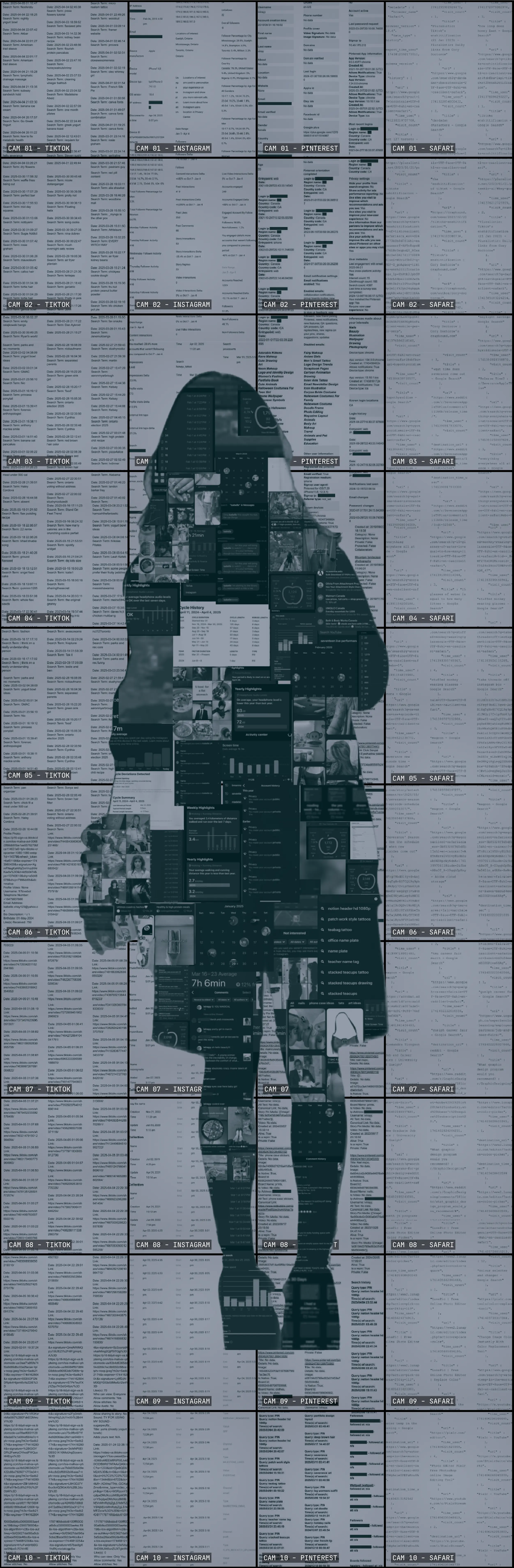
The project juxtaposes two data spheres: public (self-tracked and shared) and unseen (platform-extracted, stored, and requested). A silhouette is situated in front of a continuous, automatically scrolling background of stored data, symbolising a curated and quantified identity. The backdrop is a “behind-the-scenes” glimpse into my personal information; data that is not readily available. Using HTML code, the non-interactive format almost compels the viewer to passively consume the information, reflecting how users passively accept the extensive collection and commodification of their daily digital activities.
To structure this critique, I gathered data through direct requests on the platform or collected it firsthand. This visual consists of personal identifiers, such as emails, location data, and phone numbers, forming a raw archive of metadata extracted by the platform, and was available as downloadable files within 48 hours. This extensive dataset, containing records of my earliest activities, uncovered the overwhelming nature and scope of platform surveillance. Each platform varied in file formats and detail, making it challenging to organize equally. A random sample from each set was manually compiled into nine to ten pages of continuous data, omitting sensitive third-party information (others’ usernames, emails, and IP addresses). The background was designed to mimic surveillance camera “data footage,” a commentary on the persistent feeling of being watched online.
To portray a more public-facing version of my digital identity, screenshots from everyday apps (Notes, Messages, Instagram, Health, and YouTube) captured self-generated content and records: recent social activity, notifications, and content feeds. This collection process was more spontaneous and randomized, spanning over the last three months to illustrate how algorithms can define user identity through their activity and digital preferences.
The project visualizes the quantified self, putting into perspective the extent of personal data stored, often without our full awareness. Drawing on Kwame Appiah’s The Lies that Bind, identity itself is fluid, carrying social weight; a product of classifications that shift depending on perception, context, and interactions. Akin to social identities, digital identities evolve within an indefinite framework, able to be reconstituted and through online self-presentations and encounters, comparable to the ideas expanded by Stuart Hall’s Questions of Cultural Identity. Paralleling the “Quantified Self” movement, we make personal and collective meaning through existing structures and labels (Appiah, 5). Self-tracking fosters a new form of self-classification, one in which we subconsciously define and measure our daily lives within categories and norms such as health habits, meals, and screen time— built by algorithmic norms. We often confuse numbers as facts to piece ourselves together.
Appiah argues that identity comes with labels that influence thought, behaviour, and treatment. In online spaces, these labels become data-driven, leading to generalizations and oversimplifications that obscure the multifaceted, undocumented, and complex aspects of our offline selves. Echoing Hall, Foucault suggests that normative power produces its subjects. In the context of data surveillance, algorithms function as regulatory mechanisms, collecting and analyzing data to shape our digital experiences and perceptions, determining the communities, content, and ideas we encounter.
As humans, we crave attention and the rewards of personalization, something algorithms can offer if we teach them who we are (Kucircova). Our relationship with the internet is dual and binding; individualization now begins in the digital as much as it does in our interpersonal lives. With the amount of personal information willingly shared across platforms, users unknowingly contribute to data exploitation and breaches (cite). We seldom consider the risks of constant digital use and exposure to the ambiguities of the internet—psychologically, financially, socially, physically— when this information is manipulated or weaponized (Dutt 360).
I am convinced that these platforms know me better than I know myself, not because they understand me, but solely because they can filter and customize my experience with just a few searches or inputs. The complexities of human thought and behaviour are reduced to numerical goals, creating the perfect feed, and documenting the last thing I ate. This scroll almost becomes compulsive; a looping algorithmic affirmation.
A data visualization and self-portrait, I-Am-Data captures only bits and pieces of my life; it is a flawed, fragmented lens of digital identity. Even in this work, I unconsciously refined aspects of my online presence, constructing a version of myself for viewers to interpret. In digital spaces, identity can become performative, shaped by social recognition and validating systems. I-Am-Data reveals how we internalize and submit to categorization and surveillance, perceiving ourselves through the data we generate and track. Platforms hold both commercial and ideological, reimagining users through their online footprint.
The data featured in this work does not represent who I am, but rather what I make visible in the digital realm. I choose who to be on Instagram, TikTok, or X— none of which portray the same person. I filter my authenticity to satisfy the algorithms that keep me engaged. Identities are not static; they are a shifting form of self-expression. Yet in digital spaces, they become a product of surveillance: quantified, regulated, and incomplete.
Data surveillance is not simply about observing; it shapes us, too. We may feel a sense of control when curating our online selves, but our decisions become subtly guided by the architectures of platform control. To reclaim agency, we do not have to reject digital identity; rather, we must acknowledge and understand its constructed, algorithmic nature, which seeks to incentivize our behaviours (Inkster et al.). I-Am-Data is more than a self-portrait; it is an artistic resistance that encourages you to reimagine what it means to be seen—feel seen— in digital spaces.
References
Appiah, Kwame Anthony. “Classification: Talking Identity.” The Lies that Bind, Norton, 2018, pp. 4-12.
Dutt, Bindiya. Wellbeing Amid Digital Risks: Implications of Digital Risks, Threats, and Scams on Users’ Wellbeing. 2023, ResearchGate, https://doi.org/10.17645/mac.v11i2.6480
Hall, Stuart, and Paul Du Gay. “Introduction: Who Needs Identity?” Questions of Cultural Identity. Sage, 1996, pp. 14-16.
Inkster, Becky, et al. “Cybersecurity: A Critical Priority for Digital Mental Health.” Frontiers in Digital Health, vol. 5, article no. 1242264, 14 Sept. 2023, https://doi.org/10.3389/fdgth.2023.1242264
Kucirkova, Natalia. “How the Internet Shapes Who We Are.” Psychology Today, 29 Oct. 2021, https://www.psychologytoday.com/ca/blog/just-you/202110/how-the-internet-shapes-who-we-are.
Smee, Sebastian. “Is the digital age destroying our inner life?” The Sydney Morning Herald, 23 Nov. 2018, https://www.smh.com.au/entertainment/is-the-digital-age-destroying-our-inner-life-20181116-h17z9k.html.