
Curated by: Tristan Sauer
Author: Adrian Morra
Issue: Issue 3
Tags: Digital culture, digital art, post-internet affect, technology, softness, AI, algorithms, embodiment, nostalgia, curation, media art, human–machine relations, installation art
Bio: I, Adrian Morra, am a B.A. student majoring in Culture and Technology Studies, minoring in Marketing, with a strong passion for entrepreneurship.
Abstract: This exhibition text examines Soft Internet Theory (Art Gallery of Guelph, 2025), curated by Tristan Sauer, and responds to the contemporary internet’s shift toward automation, algorithmic repetition, and synthetic content. Positioned against Dead Internet Theory’s narrative of digital decay, the exhibition proposes “softness” as an aesthetic, political, and affective mode for reclaiming human presence within machinic systems. Through works by Marisa Müsing, Shihab Mian, Laura Moore, Devlin MacPherson, and Matt Nish-Lapidus, the show foregrounds tactility, emotional labour, temporal friction, and material memory as forms of resistance to digital abstraction. Rather than advocating Luddite retreat, Soft Internet Theory offers a model of cohabitation between bodies and computation—where code becomes ritual, devices become memorials, and interfaces mediate care rather than efficiency. In reframing softness as an assertive mode of engagement rather than nostalgia, the exhibition asks how art can restore affective depth to networked culture and keep “the human in the loop” amid rising computational dominance.
Reclaiming the Human Pulse in the Digital Age
Introduction
The internet once promised connection. It was our new commons, replacing the town square, the café, the underground bar, and the street corner. But as Tristan Sauer, curator of the Art Gallery of Guelph’s 2025 exhibition Soft Internet Theory, suggests, that promise has curdled. Today’s web is automated, optimized, and saturated with synthetic content. In Sauer’s phrasing, what once linked human minds has become a system ruled by algorithmic repetition—a “long funeral for the internet.”
Yet amid the noise, something still beats. Soft Internet Theory locates that pulse in the “soft fibres” of the digital: the handmade, the emotional, the imperfect, the tactile. Through works by Marisa Müsing, Shihab Mian, Laura Moore, Devlin MacPherson, and Matt Nish-Lapidus, the exhibition asks what remains human inside the machine and whether art can make technology feel again.
Re-Enchanting the Digital
A turquoise title wall—subtly referencing the Windows XP Bliss desktop—introduces the exhibition’s key dialectic. Against Dead Internet Theory’s diagnosis of a bot-saturated, corporatized, AI-driven web, Soft Internet Theory offers a counter-imaginary rooted in intimacy and affect. In Sauer’s curatorial framing, softness becomes a political stance rather than a decorative metaphor.
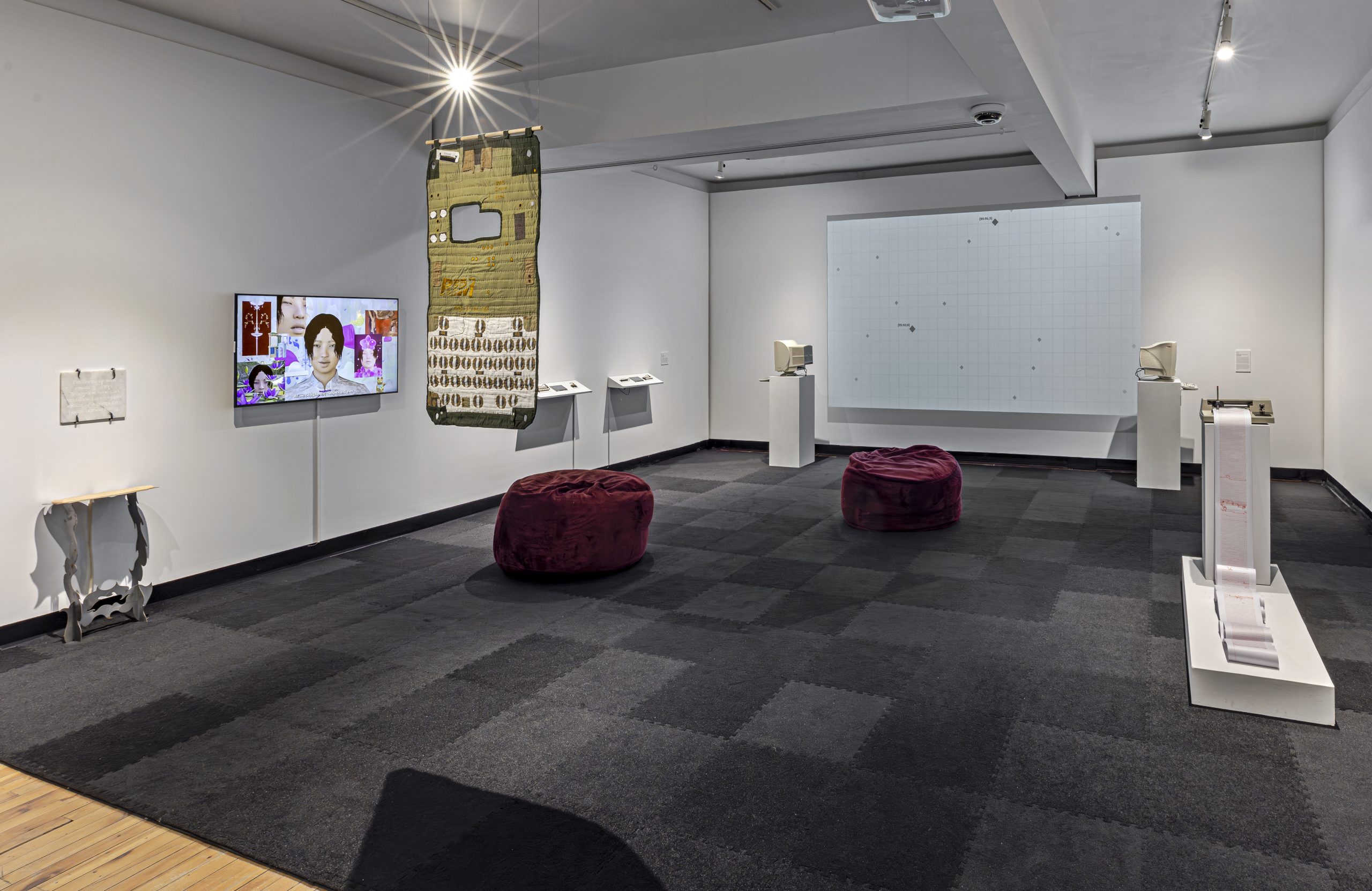
The exhibition encourages forms of engagement that privilege care, touch, and attention over speed and optimization. Screens sit beside textiles, marble tablets sit beside keyboards, while code becomes sculpture and data behaves like wind. Together, the works reclaim the emotional and material dimensions of digital culture—what Sauer calls “the heartbeat of the internet.”
Marisa Müsing: The Cyborg Who Remembered Being Human
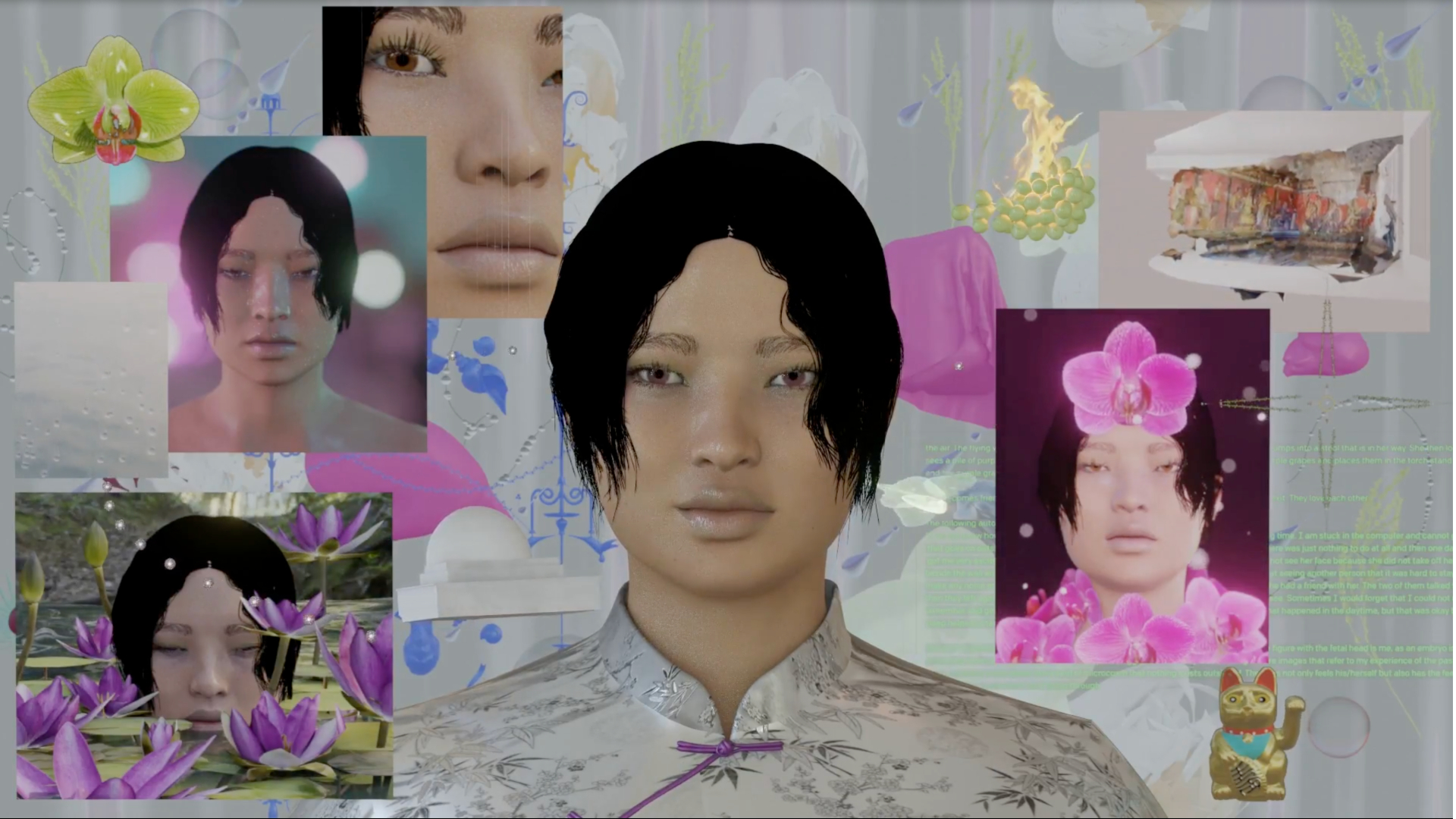
At the heart of the exhibition, Marisa Müsing’s film follows a woman trapped inside a computer she refers to as her mother. Her voice narrates existence as a digital cyborg, oscillating between synthetic embodiment and longing for touch. Drawing on an ancient fresco from Pompeii’s Villa of the Mysteries and partially written through OpenAI models, the film collapses temporal and aesthetic registers: ancient ritual meets contemporary algorithms.
A marble plaque and flesh-toned keyboard accompany the display. The engraved assertion “I am trapped inside of a computer. I am a human being” literalizes the emotional stakes: a body trying to be recognized inside a system built to abstract it. Müsing’s work foregrounds the emotional labour of digital life, where each interaction becomes a negotiation between selfhood and code.
Matt Nish-Lapidus: Pre-Written Love Letters to the Machine
Matt Nish-Lapidus presents minimalist keyboards containing only pre-selected words such as “MANIC WHISPER” and “VERY SLOWLY SPOKEN.” Each key sends a pre-written message directly into a computer, eliminating improvisation. What could be restrictive becomes unexpectedly intimate.
By forcing communication through constraint, the work transforms typing from an act of productivity into ritualized affection. As the curatorial note explains, these are “pre-written love letters to the computer,” structuring emotions routed through the interface. The keyboard becomes a confessional rather than a tool of output. Nish-Lapidus’s work crystallizes the exhibition’s thesis: creativity in the digital age is less about infinite generativity and more about intentional vulnerability.
Shihab Mian: WISP – When Weather Speaks Through Machines
Shihab Mian’s WISP reconfigures digital communication through environmental dependence. Two CRT monitors face one another, connected by a messaging system whose delivery speed is determined not by network infrastructure but by real-time local wind data. Messages drift slowly or stall, their movement visualized as a minimalist grid on the wall.
Instead of instantaneity, WISP introduces elemental delay. Communication becomes meteorological rather than mechanical. The work reframes slowness as a form of attention, challenging the expectation that technology must always accelerate.
Laura Moore: A Quilt for a Lost Interface
Suspended from the ceiling is Laura Moore’s textile reconstruction of a BlackBerry 8700, made from second-hand clothing and cotton. The sculpture transforms a once-iconic corporate device into a soft memorial object, stitching nostalgia into the literal fabric of the digital age.
Where a BlackBerry once signified productivity, urgency, and enterprise culture, Moore renders it tactile and domestic. The quilted keys and padded form evoke personal memory rather than technical function, positioning digital history as material inheritance rather than mere data storage.
Devlin MacPherson: The Drawing Machine
Devlin MacPherson’s Drawing Machine features a modified printer armed with a red pen that tirelessly draws grids of small squares on continuous paper. Left uninterrupted, it performs with mechanical precision. When viewers approach, facial-recognition sensors detect their presence and induce breakdown. Lines wobble; structures collapse; patterns grow anxious.
The scrolls pinned behind the device document these interruptions. Long sheets alternate between control and chaos, recording the psychological strain of being observed. The viewer must decide whether to stay and disrupt or withdraw and allow completion. The work transforms observation into ethical responsibility, asking whether coexistence with machines requires restraint.
Softness as Resistance
Across all works, Soft Internet Theory positions softness not as fragility but as refusal: a rejection of frictionless optimization, mass automation, and machinic indifference. Softness becomes a method of reclaiming agency in a digital environment designed to flatten nuance.
Rather than advocating technological abandonment, the exhibition models a third path—cohabitation. Artists, algorithms, viewers, and systems interact not as adversaries but as collaborators in meaning-making. Creativity arises in dialogue, not dominance.
The Human Pulse in the Machine
Ultimately, Soft Internet Theory does not romanticize a lost internet; it re-enchants the one we still inhabit. It teaches that within every circuit lies a trace of us—fragile, embodied, yearning. The exhibition invites slowness, touch, and care as strategies for digital survival. In doing so, it reframes empathy not as an analogue relic but as a technological imperative. As Sauer writes, these works “seek empathy in the digital, and write poetry into the command line.”
Perhaps that is the clearest definition of creativity in our era: the resolve to remain human in the loop.
An Inside Scoop from the Curator
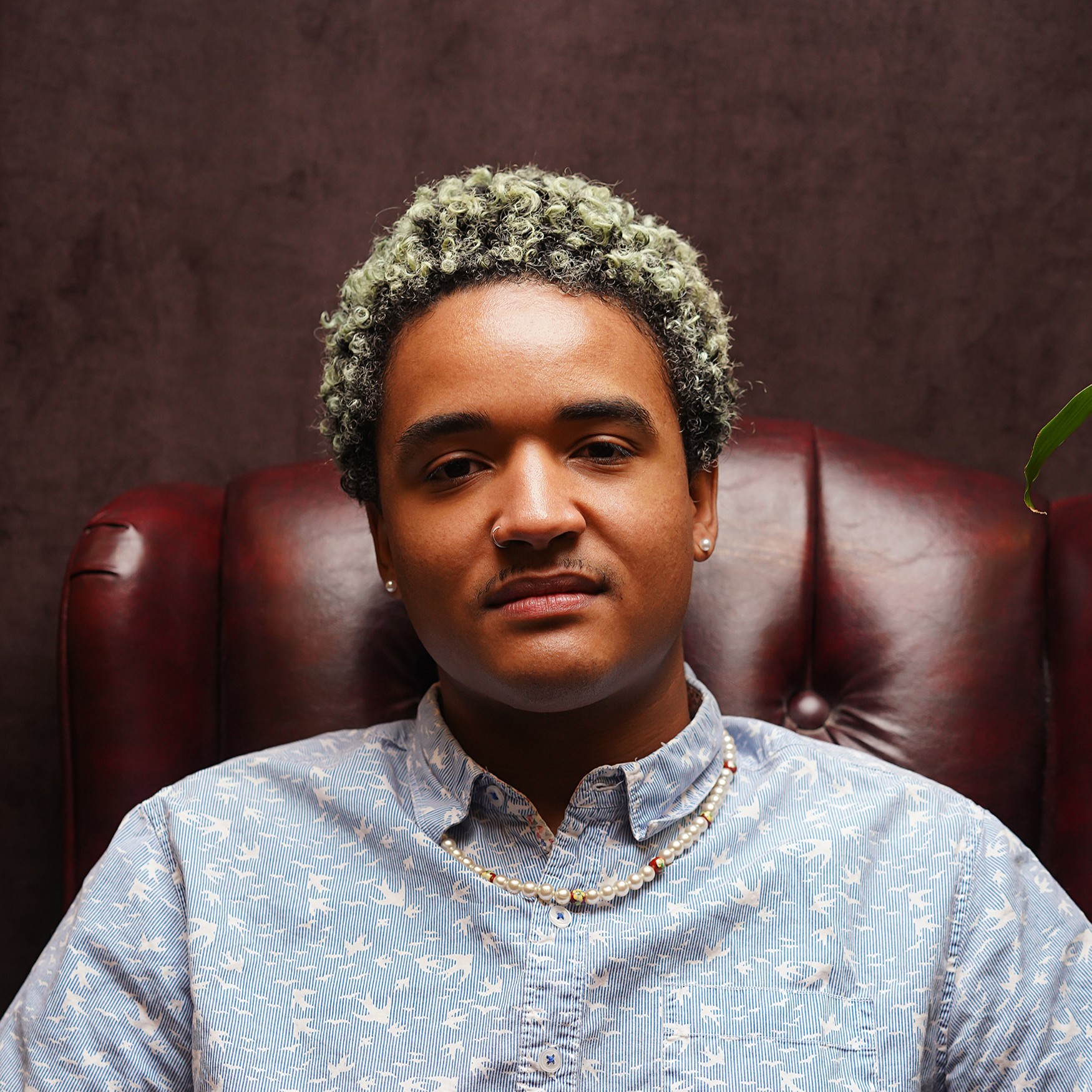
Interview with Tristan Sauer, Curator of Soft Internet Theory
1. What inspired the concept of Soft Internet Theory?
“My name is Tristan's Sauer, I am a new media artist and a curator based in Toronto Canada my practice is focused on exploring the intersections of technology and capitalism and how the relationship can often act as a modern-day Pandora's box.
This show was inspired by my lifetime observation of the internet moving away from a space that was long seen as a bastion of freedom, communication, and expression, and towards a space that is increasingly more commodified, surveilled, and for sale. The 'Dead Internet Theory', which the show borrows its name from, is a conspiracy theory of sorts that claims that the internet is dead, there are no humans on it anymore, all the content we see is made by bots and AI. Though this is obviously not true it feels more and more like reality in our current technological climate with the growth of AI and LLMs. To contrast these two points, I have always loved work that was able to find and create empathy through technology, something we generally see as sterile and devoid of emotion. The ability to make someone feel something using technology as a medium has always felt much more compelling to me than any other mediums because of how hard you have to work for those reactions. For the show I wanted to curate works that had made me feel this way. That had reminded me that the internet and technology can still be used for emotional expression as they were back in the early days of the internet, and that the internet is very much alive.”
2. When you refer to “softness” in the context of digital culture, what qualities are you emphasizing?
“Softness in this case means many things. Mainly it stands in opposition to "Dead" as it is a direct play on the "Dead Internet Theory". It also takes from the use of 'soft' in software, the untouchable parts of our technology. Softness also means empathetic, soft as in kind, and soft as in caring. Many of the pieces in the show ask you to extend empathy, write messages that are emotionally charged, or bring up feelings of care and comfort. These moments of 'softness' are in direct juxtaposition to the 'hardness' of hardware and technology in general that we interact with. Both in a literal and figurative sense.”
3. How do you see the role of artificial intelligence in digital creativity?
“AI like any other technology in the hands of an artist is a tool. There are interesting and artistically valid ways creatives can use AI to create work that is both compelling and interesting, but there are seemingly infinitely more ways in which AI is used to create meaningless slop while straight up stealing from creatives in the process. I do mainly see AI as a tool, I think it can assist in the creation of work in many capacities and can even be used to amplify or assist projects when appropriate. My favorite uses of AI in art are the ones where the lens is pointed back on the AI model itself, asking the audience to question things like the AIs implicit bias, its effect on society, and its environmental impact. Rarely do I think content that goes from AI directly to presentation is interesting or a good use of resources/the time of the audience.”
4. What do you hope viewers reflect on after experiencing your show?
“I hope viewers can reflect on how much their own digital experience is affected by capitalist interventions and tactics and try to imagine an internet that is different from the one we have. One that doesn't require a constant mining of our data to survive and isn't in a constant struggle with the erosion of what we know as true.”
5. If you had to summarize the exhibition’s core message in one sentence, what would it be?
“There is power in softness and resistance in empathy.”
References
Art Gallery of Guelph. (2025). Soft Internet Theory.
Sauer, T. (2025). Curatorial Statement: Soft Internet Theory.
Akimbo. (2025). Fall 2025 Exhibitions at the Art Gallery of Guelph.